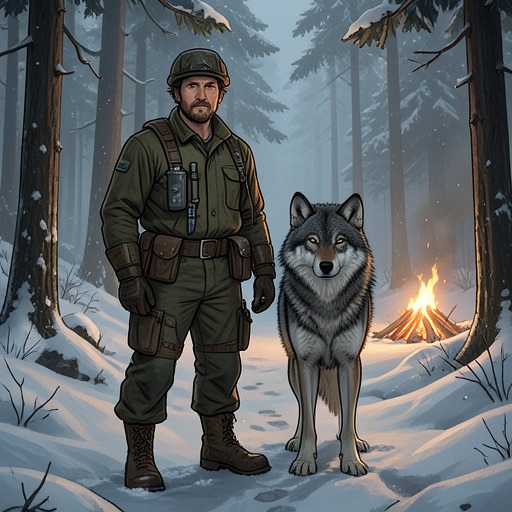
Mowat Conducts a Mouse-Eating Experiment
Never Cry WolfFarley Mowat’s mouse-eating experiment was an attempt to test a startling field conclusion with his own body: that wolves could sustain themselves, and raise families, largely on small rodents. Unable to impose a controlled diet on wild animals, he made himself the test subject. The experiment brought the argument down from observation to appetite, digestion, and a consequential mistake about fat: he initially ate dissected mice rather than whole ones, while the wolves swallowed their prey intact.
The Question Behind the Experiment
The experiment followed a change in what Mowat thought he was seeing at Wolf House Bay. As summer advanced, the mossy bogs supported abundant small rodents, and Mice increasingly appeared around Mike’s cabin and supplies. The wolf family, meanwhile, looked healthy despite Mowat’s failure to see its nightly hunters bring home large game. Angeline’s repeated pounces across the muskeg revealed the missing prey: Mowat watched her catch and swallow twenty-three mice. He concluded that the wolves at Wolf House Bay, and by inference other Barren Land wolves raising families beyond the summer Caribou range, lived largely or almost entirely on mice.
That conclusion was striking enough to require more than a dramatic observation. Mowat set out three separate evidentiary requirements. He had established that wolves caught and ate mice, and that rodents were numerous enough to support the wolf population. What remained was the question of nutritional sufficiency: could small prey maintain a large carnivore in good condition? The experiment was designed to address that third point, not simply to demonstrate that a wolf might occasionally snack on a mouse.
A Human Subject for a Wolf’s Diet
Mowat saw no way to control what the wild wolves ate. He considered borrowing two of Mike’s Huskies: one would receive only mice, the other Caribou meat when available, and both would undergo similar tests. But Mike was away, and Mowat did not know when he would return. Instead, he reasoned that although a human was not wholly carnivorous, his own metabolic functioning under a mouse regimen could offer an indication of whether wolves might survive and function normally on the same food.
His design used a single subject and two equal timed periods. During one he would eat only mice; during the other he would eat canned meat and fresh fish. He planned to conduct a series of physiological tests at the end of each period and compare the results. The approach could not provide a direct, controlled test of wolf nutrition: Mowat himself acknowledged that its implications for wolves would be indirect. The account describes the plan and his early experience on the mouse diet, but does not report a completed set of comparative test results.
Cooking, Appetite, and the Fat Problem
Mowat began at once, using the small corpses left from a morning of preparing lemmings and meadow mice as specimens. He cleaned them, put them in a pot over his primus stove, and made a stew. The many tiny bones seemed troublesome at first, but he found they could be chewed and swallowed. He considered the taste pleasing but bland, and as the diet continued, boredom diminished his appetite. To make the food less monotonous, he developed several recipes, with Creamed Mouse as the preferred one.
The recipe turned the field trial into a practical piece of cooking as well as a dietary test. It called for a dozen fat mice; the carcasses were skinned and gutted but left with their heads on, then marinated in alcohol for about two hours. Mowat fried diced sowbelly until much of its fat had rendered, coated the mice with salt, pepper, and flour, and sautéed them briefly. He added more alcohol and several cloves before simmering the pan, then covered the cooked carcasses with cream sauce and let them rest in a warm place. The recipe’s attention to gentle cooking reflected his concern that the delicate meat might dry out and become tough.
During the first week, Mowat felt that his vigor remained unimpaired and noticed no apparent ill effects. But he developed a craving for fats, which forced him to reconsider what his experiment was actually measuring. Wolves ate the whole mouse; Mowat’s dissections had shown him that rodents stored most of their fat in the abdominal cavity, along the intestinal mesenteries, rather than beneath the skin or in the muscles. By discarding the guts, he had excluded an important part of the food he meant to test. He corrected the oversight by eating the whole mouse, without its skin, and found that his craving for fat eased considerably.
What the Trial Could Establish
The experiment did not stand alone. Mowat’s conclusion that Wolf House Bay wolves relied heavily on rodents had begun with direct observation of Angeline hunting, but other evidence broadened the picture. Ootek confirmed the importance of mice and described wolves eating large numbers of ground squirrels, sometimes apparently preferring them to Caribou. He also reported watching wolves fish for Northern pike in narrow marsh channels, driving the fish toward shallower water before blocking their escape; he once saw a wolf catch seven large pike in less than an hour. These accounts showed that the diet was not a claim that wolves ate nothing but mice in every season or setting.
Later scat analysis offered another kind of evidence: about 48 percent of the samples contained rodent remains, chiefly teeth and fur. Identifiable items also included Caribou bones and hair, bird feathers, and a corroded brass button bearing a merchant-navy-style anchor-and-cable motif. The scat evidence supported the importance of rodents while also recording other food remains; the button, Mowat cautioned, was no proof that a wolf had eaten a sailor.
The self-experiment’s value was therefore both practical and limited. It forced Mowat to ask whether the animal food he had identified could meet nutritional needs, and his early experience exposed how a human test could misrepresent a wolf’s diet if it left out the fat-rich abdomen. His initial week supplied a report of maintained vigor and no apparent ill effects, not a definitive physiological verdict about wolves. The larger claim rested on a growing body of observation, Ootek’s knowledge, and scat analysis, with the experiment serving as an unusually intimate test of the assumptions behind it.